

Monkey’s Blood (Mercurochrome) for those boo-boos
Two terrifying antiseptics lurked in medicine cabinets in the United States before 1998, Mercurochrome and Merthiolate.

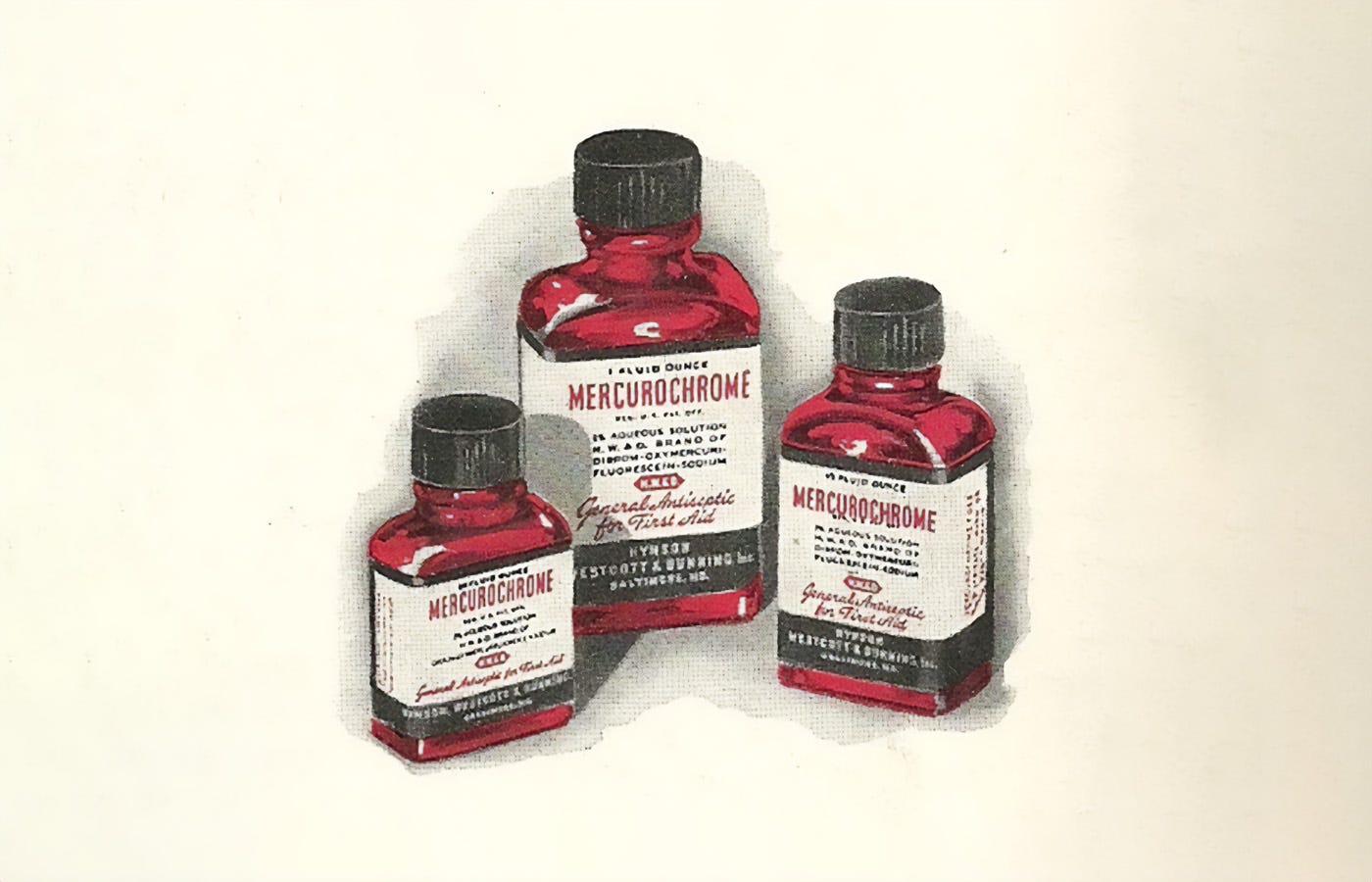
Remember when you were a kid, and you were out roughhousing with your friends? Maybe you’re running along the sidewalk when suddenly you trip and scrape your knee. You pop up, survey the damage, and realize that the whole course of your day has changed.
You have been wounded.
So you run home to your parents for evaluation. How serious will it be? According to your older sister, they are probably going to amputate, but you learned a long time ago not to trust her medical opinion. So you go to Mom.
Best case scenario? She wipes it down and sends you on your way. Worst case scenario? She takes you to the bathroom and pulls out the Monkey’s Blood. Maybe it’s a bottle of Mercurochrome or its equally dreaded cousin, Merthiolate.
Both were mercury-based antiseptics that ruled medicine cabinets from the 1910s through the 1990s. Mercurochrome (merbromin) glowed a rich, bright red-orange, while Merthiolate (thimerosal) had a similar reddish tint. Both worked as antiseptics, and both came with the same trade-off: a tremendous burning sensation when applied. It was like a bottle of lava that filled me with both dread and fascination.
Why do they call it Monkey’s Blood? Here’s the weird thing. Nobody really knows. You’d think “Monkey’s Blood” would have some complicated medical or historical origin, but the truth is the origin has been lost to time. We know it’s called that because it’s red, and we know the nickname goes back to at least the 1930s in the American South and Southwest. Spanish-speaking countries use “sangre de mono” (literally “monkey blood”) for the same stuff. But why monkey and not some other animal? Your guess is as good as anyone’s. It might have just sounded funny to kids, or maybe it was random slang that stuck around. Whatever the reason, it caught on.
Interestingly, in Northern England and parts of Britain, “monkey’s blood” also refers to strawberry or raspberry sauce on ice cream. Proof that people in different places looked at bright red liquids and thought “yep, that’s monkey blood.”
On the upside, it stained your skin reddish-orange for days. So all my friends knew I had been injured without me having to draw attention to just how tough I was.
If they only had seen me crying in agony as my mother touched the Mercurochrome applicator to the wound. But that secret is between me, my mom, and her trusty bottle of Mercurochrome.
And Mercurochrome ain’t talking anymore.
On October 19, 1998, citing potential for mercury poisoning, the Food and Drug Administration reclassified merbromin from “generally recognized as safe” to “untested,” which effectively halted its distribution in the United States. Merthiolate faced similar restrictions.
Both were later banned or restricted in other countries, though in much of the world you can still buy them over the counter. In the US, a few non-mercury containing products have been released with similar names. I don’t miss Monkey’s Blood, and if it endangered my health in any way, I’m glad it was taken off the market. But I have to admit, a small part of me takes pride in having survived repeated use of this dreaded liquid.
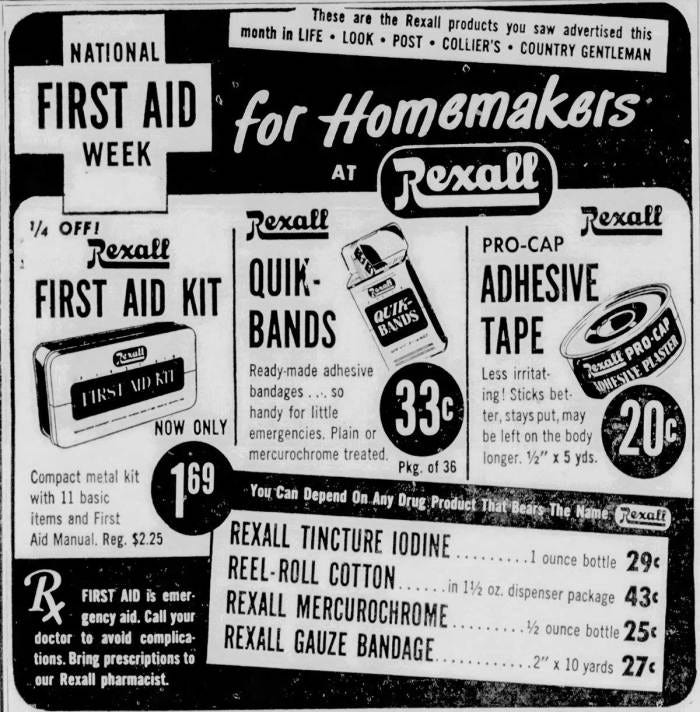
Here’s an ad for Rexall from the Fifties that mentions Mercurochrome. Not only could you get a 1/2 ounce bottle for 25 cents, but you could also get band-aids that were pre-treated with Mercurochrome.
No, I remember quite well: Mercurochrome was soothing when applied to a wound, Merthiolate was the one that burned like lava when applied to a wound.
My mother seemed to believe that the more it hurt, the more effective it was. When I got old enough to self-apply, it was merthiolate every time